
Woodworking has evolved tremendously over the years, transitioning from purely manual craftsmanship to a sophisticated blend of human skill and mechanical precision. Central to this evolution are woodworking machines, which have transformed how wood is cut, shaped, joined, and finished. Understanding the different types of woodworking machine and their uses is essential for both hobbyists and professionals who want to maximize efficiency, accuracy, and creativity in their projects.
Introduction to Woodworking Machines
A woodworking machine is a mechanical device designed to automate or assist in various woodworking tasks. From cutting and shaping wood to sanding and joining, these machines help improve precision, save time, and reduce physical effort. While hand tools remain valuable, woodworking machines are indispensable in modern workshops, enabling artisans to achieve complex designs with consistent results. Choosing the right machine depends on the type of work you perform, the scale of production, and the level of precision required.
Table Saws: The Backbone of Cutting Operations
One of the most common woodworking machines is the table saw. It consists of a circular saw blade mounted on an arbor, driven by an electric motor, and protruding through the surface of a table. Table saws are ideal for making precise straight cuts, rip cuts, and crosscuts. They can handle large sheets of wood efficiently, making them indispensable in furniture-making, cabinetry, and general woodworking projects. Modern table saws often come with advanced features such as adjustable blade heights, tilting mechanisms, and safety systems like riving knives and blade guards.
Band Saws: Versatility in Cutting Curves
While table saws excel at straight cuts, band saws offer exceptional versatility for curved and irregular cuts. A band saw uses a long, continuous blade with teeth on one edge that rotates on two or more wheels. It can cut thick, irregularly shaped wood pieces and even perform resawing tasks, splitting a piece of wood into thinner slabs. Band saws are particularly useful in creating intricate shapes for decorative woodworking or musical instruments. Their ability to cut consistently and smoothly makes them a favorite in specialized workshops.
Jointers: Creating Flat and Square Surfaces
Achieving flat, square, and smooth surfaces is crucial in woodworking, and jointers are designed specifically for this purpose. A jointer consists of a flat bed with a rotating cutter head that removes material from the wood surface. Woodworkers use jointers to flatten boards, straighten edges, and prepare stock for further processing. Properly jointed wood ensures better fitting in joinery and reduces gaps in assembled furniture. Jointers are often used in combination with planers to achieve precise thickness and smoothness across larger projects.
Planers: Thickness and Surface Consistency
While jointers create flat surfaces, planers focus on uniform thickness. A planer passes the wood through a set of rotating blades, shaving off layers to achieve a consistent thickness throughout the board. This is critical for projects requiring identical panels, such as cabinet doors or table tops. Modern planers come with adjustable depth settings, allowing for fine-tuned control. By working in tandem with jointers, planers help maintain quality, precision, and a professional finish in woodworking projects.
Router Machines: Detailed Shaping and Profiling
Router machines are versatile woodworking machines used for shaping edges, creating decorative patterns, and hollowing out areas in wood. A router typically has a rotating bit that spins at high speed, allowing it to cut intricate designs and profiles. It is invaluable in cabinetry, furniture design, and trim work. Routers can be handheld for flexibility or mounted on a table for stability and precision. The wide range of available bits makes routers suitable for complex joinery, engraving, and even inlay work, offering limitless creative possibilities.
Sanders: Achieving Smooth Finishes
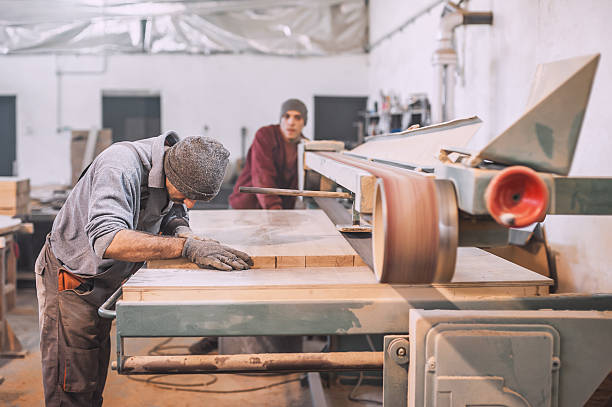
Sanding is an essential step in achieving a polished and professional finish. Sanders, a type of woodworking machine, automate this process, ensuring uniformity and efficiency. Different types of sanders serve different purposes: belt sanders are suitable for heavy material removal, orbital sanders provide smooth finishes on flat surfaces, and drum sanders handle large panels efficiently. Using sanding machines reduces manual labor and provides a consistent surface ready for finishing, staining, or painting.
Drill Presses and CNC Machines: Precision and Automation
Drill presses are dedicated woodworking machines for precise drilling, allowing for accurate hole placement and depth control. Unlike handheld drills, drill presses stabilize the wood and provide consistent pressure, improving accuracy and safety.
In the realm of advanced woodworking, CNC (Computer Numerical Control) machines represent the pinnacle of automation. CNC machines, including CNC routers and panel saws, use programmed instructions to perform cutting, shaping, and drilling with extreme precision. They are ideal for mass production, complex designs, and intricate patterns that would be difficult to achieve manually. CNC machines save time, minimize errors, and allow for reproducible results across multiple projects.
Specialized Woodworking Machines: Edge Banders, Mortisers, and More
Beyond the common woodworking machines, there are specialized machines tailored to specific tasks. Edge banding machines apply adhesive strips to the edges of panels, ensuring a polished and durable finish. Mortisers cut precise square or rectangular holes for joints like mortise and tenon, essential for strong furniture construction. Other machines, such as spindle molders and veneer presses, cater to niche requirements in decorative and high-end woodworking.
Choosing the Right Woodworking Machine
Selecting the right woodworking machine depends on your workshop size, budget, and project requirements. For beginners, versatile machines like table saws, routers, and sanders provide a solid foundation. Professionals may invest in CNC machines and specialized equipment to enhance productivity and precision. It is also essential to consider safety features, ease of maintenance, and compatibility with existing tools and workshop space.
Safety Considerations and Maintenance
While woodworking machines increase efficiency, they also pose safety risks if misused. Proper training, use of personal protective equipment, and adherence to safety guidelines are critical. Regular maintenance, including cleaning, lubrication, and blade or bit replacement, ensures optimal performance and extends the machine’s lifespan. Investing time in learning proper operation and care is as important as the machine itself.
Conclusion
Woodworking machines have revolutionized the craft, enabling both hobbyists and professionals to achieve higher levels of precision, efficiency, and creativity. From basic table saws and sanders to advanced CNC routers, each machine serves a unique purpose, contributing to the success of woodworking projects. Understanding the different types of woodworking machines and their uses helps artisans make informed decisions, optimize workflow, and unlock the full potential of their craft. Whether you are just starting or running a professional workshop, integrating the right machines into your process is key to creating high-quality woodwork efficiently and safely.